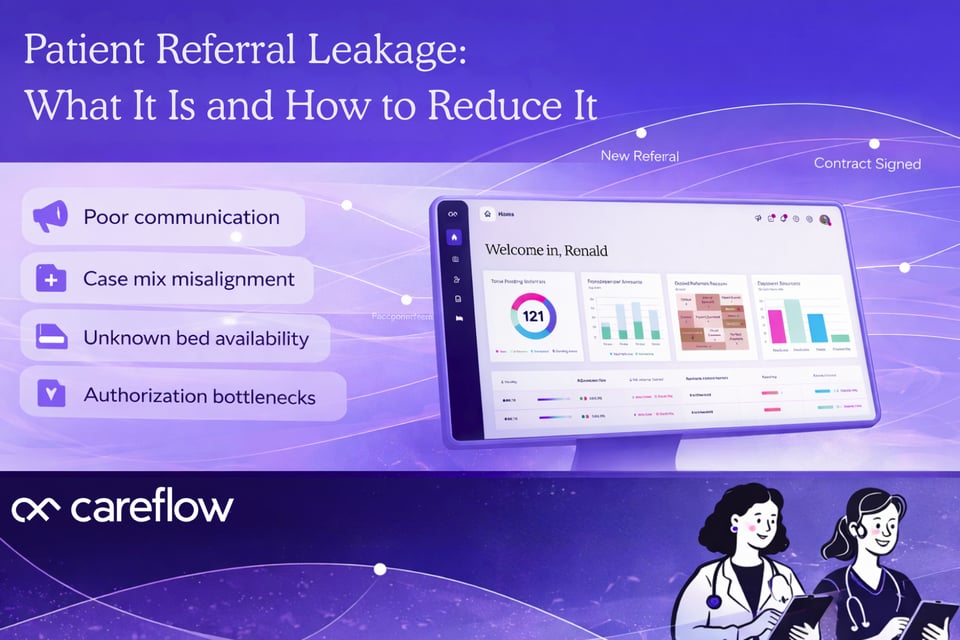
For skilled nursing providers, referrals are the lifeblood of occupancy and revenue. Yet for many facilities, many potential residents are referred but ultimately end up somewhere else either because they’re directed there or because they’re lost during the intake process.
When these folks land elsewhere, it creates patient referral leakage — a major driver of lost revenue for skilled nursing facilities and post-acute providers.
What Is Patient Referral Leakage?
Patient referral leakage occurs when a skilled nursing facility loses a potential resident to a competing facility or they fall out of the referral process altogether.
"Believe it or not, even a small number of lost referrals can make a big impact on the health of a business, reducing occupancy and revenue-generating abilities."
The Cost of Patient Referral Leakage
While each unconverted referral represents one less resident, it also means less occupancy and a chunk taken out of the bottom line. In fact, one recent study found that healthcare practices can lose up to 30% of their revenue each year to referral leakage — which means that patient referral leakage might actually be better described as patient revenue leakage.
For this reason, skilled nursing facilities need to do everything within their power to manage referrals to the best of their abilities, since admissions directly correspond to cash flow — and the overall health of the business.
What Causes Patient Referral Leakage?
The good news is that, by identifying the main drivers of patient referral and revenue leakage, skilled nursing facilities can proactively work to strengthen referral relationships, streamline admissions processes, and otherwise attract and retain more residents.
1. Poor Communication
One of the primary drivers of patient referral leakage is poor communication. When responses to hospitals, physicians, and discharge planners are delayed, facilities can lose referrals as patients seek other, more responsive options. In the event referral information is incomplete or inconsistent, decision-makers can become confused about patient needs, causing even more potential residents to slip through the cracks.
On top of this, a lack of tight coordination between admissions, operations, finance, and clinical teams also increases the risk residents end up elsewhere because they’re not admitted promptly.
Since communication gaps can weaken relationships with referral sources, it’s important to establish crystal-clear communication protocols that all staff follow, ensuring follow-up tasks are completed, which reduces the likelihood that residents are lost to competing facilities.
2. Case Mix Maximization
Skilled nursing facilities that don’t strategically manage their patient mix can find themselves facing fewer or more misaligned referrals, causing revenue leakage.
Lacking the proper strategy, tools, and attention to detail, facilities may end up prioritizing lower-revenue or bad-fit patients who cost the business money. When this happens, even referrals who might be perfect fits can be rerouted to competing facilities.
When facilities fail to optimize case mix, revenue potential decreases and clinical outcomes degrade. By analyzing referral patterns and understanding demand, facilities can proactively plan for ideal patient types, maximizing capacity and quality of care.
3. Bed Availability Intelligence
Without real-time visibility into bed statuses, the admissions process slows down, frustrating referral sources and risking lost referrals to competing facilities that can confirm availability faster.
When facilities overbook or underbook, it leads to delays in accepting new patients — which reduces revenue potential. Lacking access to accurate bed data, hospitals and discharge planners send patients elsewhere.
Without automated tracking capabilities, staff end up spending excess time verifying availability in a cumbersome manual process. With the right tools in place, they can spend more of their time converting referrals and driving revenue for the business.
4. Authorization Management
Anyone who’s worked in a skilled nursing facility knows how frustrating it can be when the process of securing insurance authorizations drags on and on. Not only do such delays impede staff productivity, they often end up causing patients to be admitted elsewhere.
Lacking the ability to track approvals from a centralized location slows things down even more. If a staff member doesn’t realize an approval has come through right away, precious time is lost facilitating the admission. Depending on how long it takes, referral sources might end up going in a different direction.
Bottom line? Inefficient authorization processes put a damper on the admission experience, increasing the risk of leakage to competing facilities.
5. Payer and Contract Intelligence
Skilled nursing facilities also miss out on opportunities when they have limited awareness of payer networks and contract requirements. This can lead to a range of challenges: bad admits, delays while waiting for information from other departments, and the risk of admitting patients at the wrong care type or level.
When facilities don’t have deep visibility into reimbursement rates, they can also make suboptimal admissions decisions — further impacting revenue.
By keeping their fingers on the pulse of payer trends, facilities can anticipate the needs of incoming referrals and increase the chances of converting them into residents.
How to Reduce Patient Referral Leakage
Reducing patient revenue leakage isn’t as simple as increasing referral volume. In fact, without the right processes and systems in place, that could even make things worse.
Instead, facilities should focus on improving their internal tools and workflows as much as they can, enabling admissions teams to move quickly — and with confidence — when opportunity knocks. Here’s how.
1. Centralize Referral Management
Since you’re reading these words, maybe this workflow will sound familiar: the grind of juggling multiple referral portals, hopping from spreadsheets to emails to EHR notes, and trying to figure out how faxes still exist in the current year.
Together, this cacophony of tools leads to missed updates, duplicated work, and slower response times — increasing patient referral leakage and, by extension, patient revenue leakage.
Having a centralized referral management system solves this all-too-common problem. Staff can view, prioritize, and track all incoming referrals without having to toggle between apps and screens — without incurring the dreaded context switching productivity losses.
This makes it easier to collaborate, assign responsibilities, and monitor progress throughout the admissions process. As a result, decisions are made faster, and your team can capitalize on more opportunities.
Even better, it leads to a smoother experience for referral partners and patients alike, increasing your chances of future success.
"Without real-time updates, staff spends valuable time trying to track down information or checking inboxes to see whether any updates have come through"
2. Get Real-Time Visibility Into Your Admissions Pipeline
In the world of skilled nursing, admissions teams often have limited visibility into where each referral stands — another common refrain across the industry. Without real-time updates, staff spends valuable time trying to track down information or checking inboxes to see whether any updates have come through.
With deep visibility into your admissions pipeline, teams can identify bottlenecks quickly and figure out ways to overcome them. Staff can prioritize high-value referrals, moving qualified patients through the process faster, converting them into residents and driving more revenue.
3. Automate, Automate, Automate
Many skilled nursing facilities are drowning in administrative tasks that slow down the admissions process and prevent staff from focusing on what’s most important.
Processes like insurance verification, status updates, and referral intake often require repetitive effort — making them prime targets for automation.
By automating as many administrative tasks as possible, facilities can keep referrals moving without tons of manual intervention. At the same time, automation can help teams rest comfortably knowing that no critical steps were missed — a win-win.
4. Improve Communication Across Admissions Teams, Staff, and Residents
When admissions coordinators, clinical teams, and administrative staff can’t communicate effectively, referral leakage is right around the corner. Each of these groups needs timely updates, ideally in real time, to move referrals forward.
Strong internal collaboration tools help facilities overcome this challenge. Every team member can stay aligned on statuses, requirements, and next steps for each resident.
At the same time, collaboration tools can also help staff efficiently communicate with patients and their families, which is crucial for setting expectations, building trust, and delivering a positive resident experience.
The better your communication and collaboration capabilities are, the less patient revenue leakage you’ll incur.
5. Use Data to Continuously Refine Your Referral Strategy
Even the highest-performing skilled nursing facility can improve. By investing in tools that streamline admission workflows and give teams more visibility into referrals, facilities can maximize more opportunities and drive more revenue because of it.
With the right data, decision-makers can figure out where referrals are being lost and why. Teams can also identify trends, measure performance, and fine-tune their strategies over time.
It’s an easy way to continuously improve admission performance while converting more resident referrals that are already coming your way.
Solve Your Patient Referral Leakage Problems and Drive More Revenue!
Patient referral leakage is a common challenge for skilled nursing facilities. Not only does it impact revenue, it also affects occupancy rates and frustrates staff and residents alike.
By identifying the key drivers of patient referral and revenue leakage — including poor communication, bed availability, and case mix misalignment — and taking proactive steps to address them, your facility can accelerate admissions, increase data visibility, and transform into a more efficient operation that maximizes opportunities and sets new standards of care.

Ready to solve your patient referral leakage problems? Find out how Careflow bridges the revenue leakage gap.
This post was written by Justin Reynolds. Justin is a freelance writer who enjoys telling stories about how technology, science, and creativity can help workers be more productive. In his spare time, he likes seeing or playing live music, hiking, and traveling.
.png?width=352&name=26_NSC_Collages.pptx%20(1).png)
%20(7)-1.png?width=352&name=From%2080%25%20Rejection%20to%20Instant%20Admission%20(1200%20x%20628%20px)%20(7)-1.png)
.png?width=352&name=AE%20Content%20Round%202%20(2).png)