.png?width=960&height=640&name=AE%20Content%20Round%202%20(2).png)
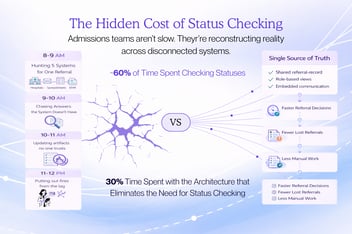
I've watched teams with documented best practices in binders and PDFs completely ignore them in daily work. The written process looked pristine. The live workflow at 3 p.m. on a Tuesday was something completely different. This isn't a training problem or a discipline problem. It's an architecture problem.
The Best Practice Paradox
Most admissions teams have documented best practices. Few follow them consistently.
In one facility, the written process for hospital referrals was clean: centralize all referrals in a shared inbox, log each into the CRM within 15 minutes, pull clinical and financial data from connected hospital systems before any back-and-forth, track every status change inside the platform.
If you read the SOP, it sounded like a machine.
When I visited the admissions office, the real workflow was running on sticky notes, text messages, and memory. Referrals were coming via fax, email, Epic messages, and phone. The gatekeeper was whoever happened to be closest to the printer. Instead of logging into a system, people were printing referral PDFs and stacking them in piles labeled "hot," "maybe," and "tomorrow."
In one moment that stuck with me, a marketer walked in waving a fax: "This one is from St. John's, we've been trying to get in with their discharge planners - can we please take this one?" No one checked the documented queue. They reprioritized on the spot based on relationship and who was yelling loudest.
The binder lost to reality.
When I asked why they weren't following the documented process, no one said they didn't care about best practices. What they actually said was: "The system is too slow when we're slammed. It's faster to just print and move." "Half the time the referral doesn't land in the right queue anyway, so I don't trust it." "Corporate needs the reports. We need to keep beds full. The binder is for them, this is how we survive."
The documented playbook assumed stable volumes, clean data feeds, and time to click through workflows. Daily reality was bursts of referrals late in the day, incomplete clinicals, and constant pressure to respond faster than competing facilities.
Shadow Systems Reveal Hidden Logic
Shadow systems aren't chaos. They're sophisticated decision-making tools that official software can't see.
The piles felt faster because they optimized for instant visibility and survival under pressure. Staff could glance at three piles and know exactly where to jump next—no login, no spinning wheel, no navigation.
They optimized for response speed, cognitive simplicity, and local control. The standardized queue didn't reflect the actual incentives driving admissions: relationship value, payer friction, or operational reality.
SNF referral rejection rates climbed to 88% by Q1 2022. Patient acuity increased 34% since 2019, with average comorbidities growing from 3.4 to 4.96 between 2019 and 2024. Best-practice documentation hasn't kept pace.
The Hidden Logic That Keeps Beds Full
Here's a concrete example of how official rules diverge from real prioritization logic.
The SOP said "first-come, first-served by clinical urgency." The real logic at the desk was "protect key hospital relationships and high-value payers first, then fill in the rest."
At 3:30 p.m., census was tight and two beds were opening the next morning. Three referrals hit within 20 minutes:
Referral A: Medicaid, from a small outlying hospital, clinically straightforward.
Referral B: Medicare Advantage, from a mid-volume hospital, with a notoriously slow and picky plan attached.
Referral C: Traditional Medicare, from the big tertiary hospital that sent a large chunk of high-margin volume every month.
In the official queue, sorted by time then acuity, Referral A was technically "next." On the floor, the conversation sounded like this: "Take C first. If we drag our feet on that hospital again, they'll start sending to the competitor down the road." "We can probably squeeze in A if one more discharge happens. B is a maybe—we know that MA plan eats days in prior auth and underpays."
The true prioritization became: protect the flagship hospital relationship, preserve payer mix and margin, then consider the time and urgency ordering that the SOP described.
The paper piles on the desk reflected this hidden logic perfectly. C's fax went straight into the "hot" pile on top. A's got parked in "maybe." B's often slid into "tomorrow" unless census was really hurting.
The standardized queue didn't encode any of that. It saw timestamps and generic clinical tags, not relationship value, likely margin, or operational friction.
How Careflow Translates Hidden Logic Into Structure
When we built Careflow, we turned that hidden, pile-based logic into explicit, configurable scoring and routing rules. Then we hid the complexity behind a workspace that still feels as fast and intuitive as those piles.
We ingest payer, plan, and sometimes even product, and allow configurable lift or penalty in the score based on historical denial rates, auth friction, and contribution margin. We combine clinical criteria with operational context so "good fit for us today" is reflected directly in how referrals are ranked.
The real logic—"protect Hospital X, avoid Plan Y when we're tight, favor cases that match our strengths"—is encoded in a rules engine instead of in sticky notes and hallway folklore.
But we were careful not to make users feel like we'd just digitized their workarounds.
Admissions staff see one prioritized queue that already reflects all those factors. They don't have to manage weights or think in terms of scores. They just work from the top like they used to work from the top of the "hot" pile.
Next to each referral, we show a short explanation: "High priority: flagship hospital + strong Medicare plan + good ortho fit." This mirrors the way they already talk about cases out loud.
Staff can still manually bump something up or down with a reason code. They don't feel trapped. But those overrides are visible and learnable, not invisible like paper reshuffling.
For frontline teams, Careflow feels less like a system automating their hacks and more like a system that finally gets why they were hacking in the first place.
When Overrides Become Your Best Data
One pattern changed my mind about how we score referrals.
The system kept confidently pushing Friday afternoon Medicare Advantage referrals to the top of the queue. The team kept shoving them down with the same override reason: "Friday friction - no auth until Monday."
Initially, our rules said a referral like this should be high priority: strong clinical fit, bed available on the right unit, Medicare Advantage with decent headline rates, from a solid repeat hospital referrer.
Over a few weeks, we saw a pattern: overrides clustered between 2:30 and 5:00 p.m. on Fridays for complex MA patients needing prior auth. Users repeatedly pushed these referrals down, even when beds were open.
From the system's perspective, staff were ignoring good referrals. From their perspective, they were avoiding pain: admit at 6 p.m. Friday, but no one at the plan answers until Monday. You're now carrying a complex patient with no auth and high denial risk.
The override pattern told us our rules were misaligned with reality in a very specific way. We'd priced financial attributes into the score but not temporal and operational friction.
We adjusted Careflow: added time-aware friction so certain payers carry a "Friday afternoon penalty" when they require live prior auth. We encoded auth dependence. We made the logic visible: "Medium priority: strong plan, but prior auth office closed until Monday."
The staff weren't resisting automation. They were teaching us that when and under what conditions you take a "good" payer matters as much as the payer itself.
Once we listened to that signal and baked it into the rules, the queue started to feel less like an out-of-touch boss and more like the smartest version of their own judgment.
What Changes When Excellence Becomes Structural
When that transition actually works - when a facility goes from "we survive because Sarah knows everything" to "the system makes the right thing obvious" - the language shifts from firefighting and blame to predictability and tradeoffs.
You stop hearing stories about people saving the day and start hearing stories about the day going how it was supposed to.
In hero-dependent chaos: "If Sarah hadn't caught that referral, we would've lost it." "I just grabbed the faxes and did what I could."
When it works: "The queue pushed the two ortho cases to the top, so we cleared those first." "Careflow flagged that MA patient as a Monday admit extra the weekend stayed calm."
Pride shifts to system reliability: "Our response time is under an hour now." "Fridays used to be brutal. Now they feel like any other day."
People talk less about remembering and more about deciding.
That's when you know you've moved from Sarah-dependent survival to a Careflow-shaped system where the right thing is obvious, even when Sarah is on vacation.
The Fundamental Misunderstanding
Most organizations assume admissions excellence is a training and heroism problem. They keep trying to hire, train, and hold people accountable their way out of what is actually a structural gap.
The default belief is: "We already know the best practices—we wrote them in the SOP. If people would just follow them, we'd be fine." When performance slips, the response is more training, more dashboards, more meetings, and eventually more headcount to stay on top of referrals. That mindset ignores misaligned incentives, payer friction, local constraints, and the fact that referrals hit real humans in messy patterns that the binder never modeled.
The organizations that actually scale admissions excellence flip the assumption. They stop asking, "Why won't people follow the process?" and start asking, "What would the process have to feel like for people to follow it on their worst day?" They invest in a structure - a rules engine, shared patterns, local knobs, safe overrides - that makes the right behavior the path of least resistance.
That's what we're building with Careflow. A system where the real economics, politics, and constraints of admissions are encoded into the workflow itself, so excellence is something the organization can operate on purpose.
Not something it hopes a few exhausted heroes can keep recreating every afternoon at the fax machine.
References and Further Reading
- Careflow Platform - https://www.gocareflow.com
-
Best Practices for Referral Management - CarePort Health
https://careporthealth.com/resources/blog/best-practices-for-referral-management/
%20(7)-1.png?width=352&name=From%2080%25%20Rejection%20to%20Instant%20Admission%20(1200%20x%20628%20px)%20(7)-1.png)