NIC Spring 2026 brought together operators, investors, and leaders across post-acute care to discuss where the industry is heading. Across sessions, conversations consistently pointed to the same themes: growing demand, increasing complexity, and continued pressure on operators to do more with less.
But one session, “Leading the Transformation: Skilled Nursing Models for Tomorrow,” stood out. It brought together leaders from Marquis Health, Ensign Services, Touchstone Communities, and Larry H. Miller Senior Health who are not just responding to change, but actively shaping how skilled nursing organizations operate in today’s environment. And what came through clearly is that while the industry is benefiting from strong tailwinds, performance is not being distributed evenly. Some organizations are pulling ahead, and the difference is no longer market-driven. It is operational.
While these insights were grounded in a single session, they were echoed consistently across conversations, panels, and operator perspectives throughout the conference. What emerged wasn’t a set of isolated takeaways, but a clear operating pattern. The themes below reflect that progression, from market dynamics to operational realities to the factors now driving performance.
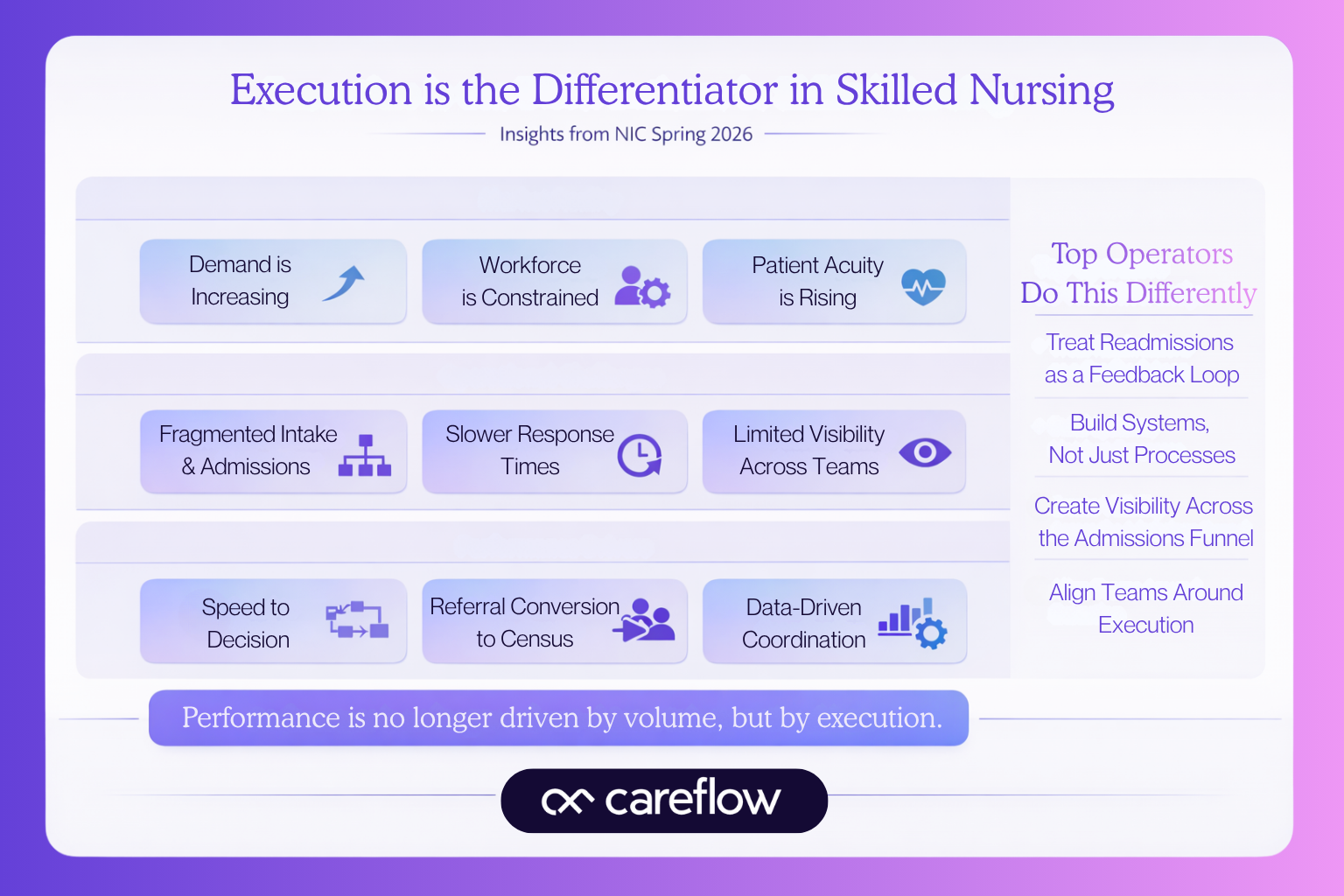
1. A Market Defined by Demand, but Not Guaranteed Performance
Why this matters:
Strong demand creates opportunity, but it no longer guarantees growth. The gap between high- and low-performing operators is widening, and it is being driven by execution, not market conditions.
- 15–16% of hospital discharges result in SNF referrals, while only 17% to 19% convert to admissions, highlighting a gap between demand and realized census (Skilled Nursing News, 2025)
- Facilities accept 40% to 60% of incoming referrals, leaving a meaningful portion of potential admissions unrealized (industry benchmarks)
- Delays in referral response and intake workflows are a leading driver of lost admissions, with slower response times directly reducing conversion rates (HealthViewX)
- Skilled nursing occupancy reached 79.6%, still 8.2 percentage points below the pre-pandemic level of 87.8%, with operational constraints continuing to limit admissions (NIC)
- Annual staff turnover exceeds 50%, contributing to inconsistent intake processes and missed referral opportunities (PHI)
- More than 600 nursing homes have closed since 2020, with access to care continuing to decline across the U.S. (AHCA/NCAL)
These dynamics should create favorable conditions across the board. But they are not. What’s becoming increasingly clear is that demand is not the differentiator. The ability to operate effectively within a more complex environment is.
What stood out is how wide the performance gap has become between operators in similar markets. Two organizations can be facing the same external conditions and seeing similar referral volume, yet producing very different census and financial outcomes. That gap is not driven by access. It is driven by how effectively organizations operationalize demand, how quickly they act on opportunity, and how consistently they convert it into results.
2. The Operating Environment Is More Complex Than It Appears
Why this matters:
What looks like a volume challenge is often an execution challenge. Without addressing operational complexity, additional demand only amplifies inefficiencies.
From the outside, skilled nursing demand appears straightforward: referrals come in, patients are admitted, census grows. In practice, the path from referral to admission is fragmented across systems, teams, and decision points. Referrals arrive from multiple sources. Clinical review, documentation, and payer verification are often handled across disconnected workflows. Communication between intake, clinical, and operations teams is rarely centralized. The result is not just inefficiency, but inconsistency. Delays in response, missed follow-ups, and limited visibility into referral status all contribute to lost opportunities that are often invisible at the surface level.
As complexity increases, the ability to centralize information, coordinate workflows, and create real-time visibility across teams becomes critical. Without that, organizations are left managing a fragmented process that is difficult to scale and even harder to improve.
3. Partnerships Are Becoming More Performance-Driven
Why this matters:
Relationships may generate referrals, but they no longer determine outcomes. Performance is now defined by how quickly and effectively organizations can act on opportunity. For years, growth in skilled nursing was heavily tied to relationships with hospital partners and referral sources. Those relationships still matter, but they are no longer sufficient.
As one panelist noted, the expectation from hospital partners has shifted. Speed, clarity, and consistency now carry more weight than familiarity. If a facility cannot respond quickly or provide confidence in placement, referrals move elsewhere. This marks a fundamental shift. Relationships open the door, but execution determines whether an organization captures the opportunity.

4. Quality, Ratings, and Readmissions Are Now Financial Drivers
Why this matters:
Clinical performance is no longer separate from financial performance. Outcomes, ratings, and readmissions now directly influence reimbursement, referral flow, and long-term margin.
Performance is now evaluated through a more integrated lens. Quality outcomes, publicly reported ratings, and readmission rates are interconnected signals that shape both perception and financial results. Five-star ratings influence how facilities are viewed by hospital partners, patients, and families, often impacting referral decisions before a conversation even begins. At the same time, readmissions offer a clearer view into how well an organization is actually operating.
If you want to understand performance, look at readmissions. They reflect more than clinical outcomes. They reflect coordination, decision-making, and what happens after discharge. They answer questions like:
- Were the right patients admitted?
- Was care managed effectively during the stay?
- Was the transition out of the facility handled well?
Leading organizations are treating readmissions as a feedback loop, not just a metric. They use it to refine admissions decisions, care management, and post-discharge processes. As reimbursement models continue to evolve, these factors are increasingly tied to financial outcomes. Performance is no longer measured by volume alone, but by how effectively organizations manage the full episode of care.
5.Census Still Drives Everything, But It’s No Longer a Volume Game
Why this matters:
Census is still the primary driver of financial performance, but it is no longer a function of referral volume. It reflects how effectively organizations convert and manage demand.
“Fix census, fix everything.” That idea hasn’t changed. Census used to be driven largely by volume and relationships. Today, it’s driven by execution inside the admissions process. Census is the metric that operators ultimately care about. It reflects both revenue and operational stability.
What has changed is how it is built. It is no longer a function of referral volume or relationships alone, but of how effectively organizations execute within the admissions process. Today, census is shaped by how well teams convert, manage, and retain patients across a series of interconnected actions:
- How quickly referrals are reviewed and responded to
- How effectively patients are matched to the appropriate level of care
- How clearly teams communicate across intake, clinical, and operations
- How consistently follow-up is managed throughout the decision process
- How efficiently patients are transitioned from referral to admission
What’s changing is not just what needs to be done, but how consistently it can be executed. Organizations that are able to systematize these workflows, rather than relying on manual coordination, are seeing more predictable conversion and stronger census outcomes. Those that do not often experience leakage at multiple points in the process.
Census, in this environment, is not a top-of-funnel problem. It is an execution outcome.
6. Data and Culture Are the Differentiators
Why this matters:
The organizations pulling ahead are not operating in a different market. They are operating with greater visibility and stronger accountability, which allows them to execute more consistently.
What separates high-performing organizations is not access to more referrals or fundamentally different resources. It is how they operate internally. In many cases, that visibility is not just a reporting improvement. It is a systems improvement. When data is centralized and accessible in real time, teams can act faster, make more confident decisions, and operate with a level of coordination that is difficult to achieve in fragmented environments. Data plays a central role. Without clear visibility into referral flow, response times, conversion rates, and outcomes, teams are forced to operate reactively. Issues surface late, and opportunities are missed without clear attribution. But data alone is not enough.
Culture determines how that information is used. Organizations that outperform tend to have clear ownership across the admissions process, faster decision-making, and a shared understanding of what good execution looks like. They do not rely on individual effort or institutional knowledge alone. They build systems and expectations that make performance repeatable. What stood out is that the strongest operators are not leaving this to chance. They are building cultures where expectations are clear, performance is visible, and accountability is part of how the business runs day to day.
In that sense, data provides the visibility, but culture determines whether it translates into action.
Execution Is the Differentiator
Across NIC Spring 2026, one theme was consistent. Demand is not the constraint. What this particular session clarified, and what showed up across the broader conference, is why performance is no longer evenly distributed. This is not a volume-driven environment anymore. It is an execution-driven one.
The operators pulling ahead are not seeing more opportunity. They are converting it more effectively, with greater alignment across teams, clearer visibility into performance, and faster, more confident decision-making.
They understand how demand moves through their organization, where it slows down, and where it is lost, and they have built the discipline to act on that in real time. Increasingly, this comes down to how well organizations have built the systems and infrastructure to support that level of execution.
That is what is separating performance today, and that is where the industry is heading.
References & Sources:
- Skilled Nursing News
https://skillednursingnews.com/2025/12/hospital-to-skilled-nursing-facility-referral-rate-stable-admission-rate-rises/ -
U.S. Census Bureau
https://www.census.gov/library/publications/2020/demo/p25-1144.html -
PHI National
https://www.phinational.org/resource/direct-care-workers-in-the-united-states-key-facts-2023/ -
AHCA/NCAL
https://www.ahcancal.org/News-and-Communications/Fact-Sheets/FactSheets/Nursing-Facility-Closures.pdf - NIC
https://www.nic.org/blog/skilled-nursing-occupancy-remains-below-80/
%20(10).png?width=352&name=From%2080%25%20Rejection%20to%20Instant%20Admission%20(1200%20x%20628%20px)%20(10).png)
.png?width=352&name=AE%20Content%20Round%202%20(2).png)