Low Census: What It Is and How to Improve It
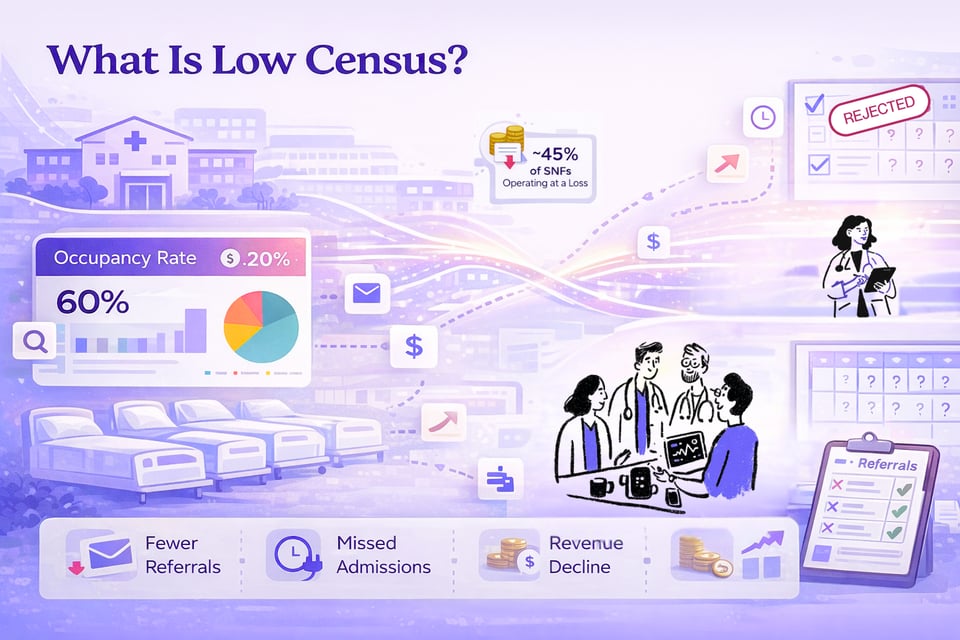
As skilled nursing facilities continue to recover from the pandemic-induced downturn, nearly half of them remain under financial strain. In fact, according to one recent study, 45% of facilities were operating at a loss or negative margin in 2024.
With margins in skilled nursing already thin, even minor shifts in census can have a huge impact on the bottom line. To build a more resilient and profitable operation—one that’s well-positioned to provide exceptional care and deliver strong patient outcomes—skilled nursing facilities need to address low census head-on.
What Is Low Census?
Low census refers to a decrease in the number of beds occupied by patients at a skilled nursing facility. The metric is most often measured via occupancy rates, with anything lower than 80% being considered too low for skilled nursing. Depending on a confluence of factors—like referral volume, staffing availability, and market dynamics—low census can be temporary or persistent.
When facilities struggle with low census, beds remain unfilled despite having the capacity to care for more patients. Facilities also admit fewer residents than expected and have to navigate inconsistent patient volume. Since skilled nursing facilities are paid based on occupancy, low census can have a major impact on revenue. In addition to dollars and cents, low census creates operational inefficiencies and staffing challenges.
For example, staff might be called off due to lower patient volume while teams struggle with unpredictable schedules. Depending on how inconsistent things get, staff can have a hard time maintaining their skills, especially in specialized units.
What Causes Low Census?
Low census is typically caused by several issues that compound across the referral and admissions process. Often, demand for beds exists. It’s just that facilities struggle to convert that demand into admissions.
Addressing low census starts with understanding its underlying drivers. Only by identifying where breakdowns occur can facilities take meaningful steps to boost occupancy and build a more resilient operation.
1. Referral Flow Challenges
When skilled nursing facilities have inconsistent referrals from hospital and healthcare partners or have weak relationships with key referral sources, they incur referral leakage risks as competing facilities attract more residents.
2. Intake and Admissions Delays
If staff aren’t able to efficiently process incoming referrals—perhaps because they’re still relying on fragmented, manually driven intake processes that slow down decision-making—skilled nursing facilities can miss out on opportunities.
3. Staffing Constraints
Facilities impacted by staffing shortages may also be unable to safely admit new patients. They also might have to turn referrals away even though they have enough available beds—or because available staff might not be able to adequately address patient acuity needs.
4. Market and Care Delivery Shifts
As home health and alternative care options continue to grow, increased competition can impact demand for skilled nursing facilities—making it trickier to maximize occupancy.
5. Internal Operational Gaps
When teams aren’t able to smoothly coordinate across clinical, admissions, and administrative staff, facilities struggle with inefficient bed management and poor visibility into occupancy. As a result, it’s harder to match incoming patients with ideal care capabilities, further impacting census.
Add it all up, and low census has less to do with a lack of demand and is mostly rooted in breakdowns in coordination, visibility, and speed.
What Does Low Census Mean for Staff?
While low census impacts the bottom line, it also has an effect on staff schedules and morale. Since staffing levels are directly correlated with patient volume, fluctuations in census can quickly translate into workforce changes.
Schedule and Income Instability
Facilities impacted by low census often ask staff to stay home and work fewer hours simply because there are fewer patients to accommodate. For staff, less predictable hours can lead to financial stress, and it can also make it harder to maintain an optimal work-life balance.
Operational Disruptions
When dealing with low census, staff may be asked to take on different roles as they constantly adjust to changing patient volumes and evolving care needs. In these environments, workflows become inconsistent and mostly reactive to the day’s most pressing needs.
Staffing Imbalance Challenges
Facilities dealing with low census might find their fortunes reverse quickly, with sudden spikes in occupancy. Such volatility makes it nearly impossible to maintain optimal staffing levels, causing facilities to deal with overstaffing at certain times and shortages at others.
Morale and Retention
Unpredictable schedules and rapidly changing job responsibilities can cause staff to become frustrated and disengaged. Depending on how bad it gets, this could lead to burnout—something that nearly half of healthcare workers struggle with.
Over time, these factors cause employees to start looking for greener pastures elsewhere, which leads to higher turnover and ongoing staffing challenges.
How Can Skilled Nursing Facilities Improve Low Census?
While low census can have a devastating impact on operations, the good news is that there are proactive steps skilled nursing facilities can take to capture more referral volume and convert it into admissions.
Streamline Referral Intake and Response
The more efficient the referral intake process is, the easier it is to improve census. As such, skilled nursing facilities should do everything they can to centralize referral intake, eliminate fragmented communications channels, and otherwise enable faster referral responses. By doing so, they can reduce delays that lead to lost placements.
Improve Care Team Collaboration
Streamlining the intake and response process is only possible when employees can collaborate seamlessly with each other.
By investing in tools that deliver a shared workflow environment, facilities can connect admissions, clinical, and case management teams, enabling real-time communication that speeds up acceptance decisions. At the same time, such tools also reduce the back-and-forth communication that typically slows down admission decisions.
Increase Visibility Into Capacity and Readiness
When staff have clear, real-time visibility into admission readiness and bed availability, they can quickly identify where patients can be placed without any delays. As a result, they can capitalize on the best opportunities, always.
Reduce Administrative Burdens
By taking as many manual tracking tasks off your team’s plate, automating workflows, and centralizing systems, facilities can free up staff time that can be spent on patient placement—not administrative busywork. The right system can improve consistency in how referrals are handled across teams, reducing delays and missed follow-ups while ensuring more referrals move smoothly through the intake process and ultimately become residents.
How to Maintain Census Once You Hit 85%
Reaching 85% occupancy is a major milestone for skilled nursing facilities. But the real challenge is staying there consistently—or even boosting occupancy rates closer to 100%—without introducing more complexity to your operations or putting more stress on employees. Here’s how to make that happen.
Standardize Referral Conversion Processes
By standardizing intake workflows, facilities can ensure that each referral is handled quickly and consistently—and that no viable referrals are lost due to delays or a lack of follow-up. Focusing on increasing conversion rates from existing volume instead of chasing more referrals can help you maximize what’s already coming your way without having to reinvent the wheel.
Increase Speed Without Adding Staff
Investing in a centralized referral management platform enables you to automate repetitive workflows and reduce manual effort in intake and coordination, enabling faster decision-making that ensures beds are filled more efficiently. It’s an easy way to improve occupancy rates without requiring additional headcount—or, in some cases, even doing so while reducing headcount a bit.
Maintain Visibility and Control
With purpose-built software, skilled nursing facilities can track bed availability, referral performance, and conversion trends in real time. This enables staff to identify bottlenecks early in the process, before they impact occupancy. Instead of guiding decisions with guesswork, the right tools allow you to continuously optimize your admissions flow based on data.
Ready to Increase Census at Your Facility?
If you’re looking to increase admissions and referral conversion rates at your facility without adding headcount—or even reducing staff—Careflow can help. Our system is designed to help organizations like yours scale census sustainability—without any heavy lifting or added operational complexity. With Careflow, your team can move faster, stay on the same page, and enjoy complete visibility into operations—all from one central interface.
%20(9).png?width=352&name=From%2080%25%20Rejection%20to%20Instant%20Admission%20(1200%20x%20628%20px)%20(9).png)
.png?width=352&name=Undesranding%20the%20Patient%20Intake%20Process.%20(2).png)
.png?width=352&name=AE%20Content%20Round%202%20(5).png)